


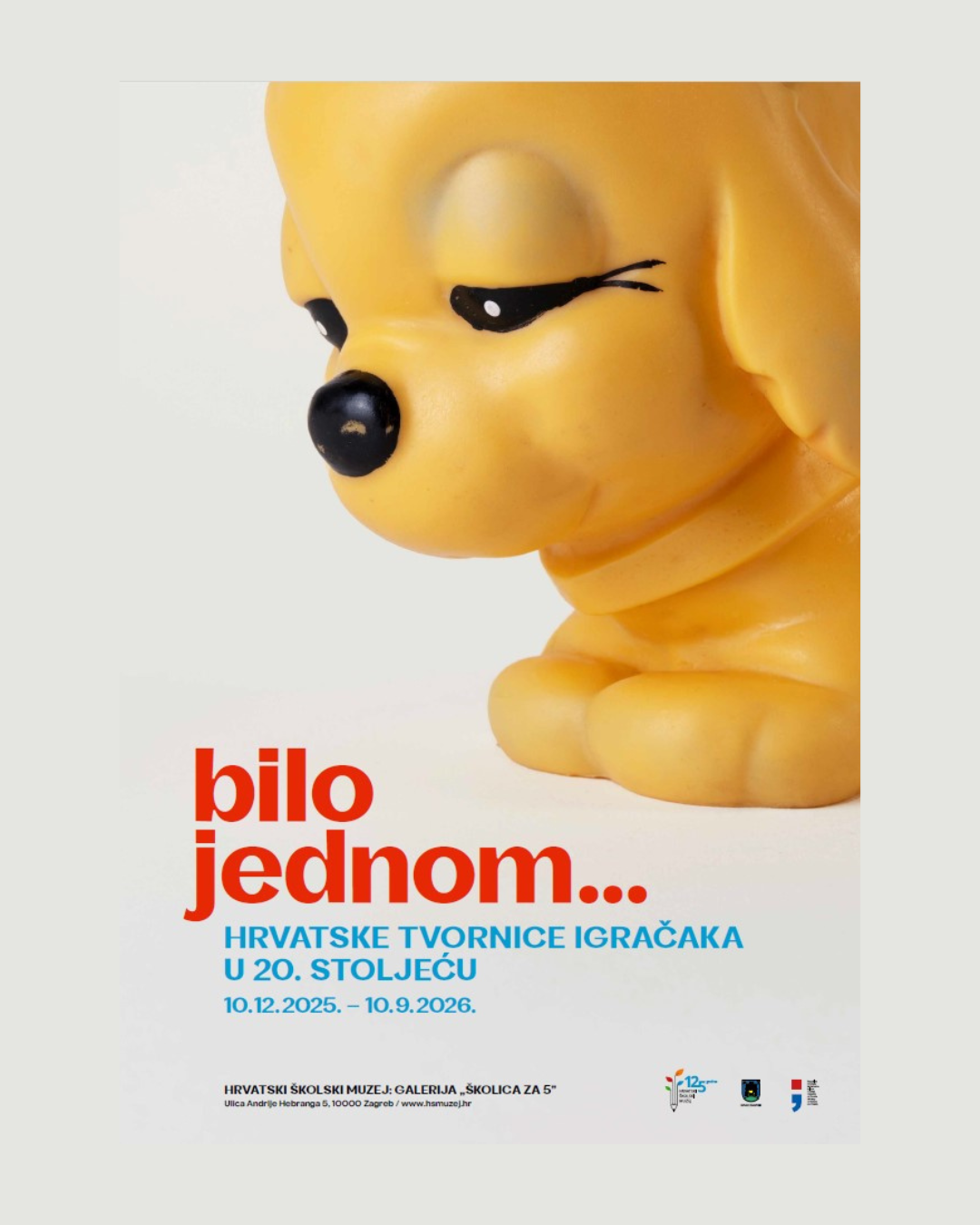

Curator-led tour of the exhibition Once Upon a Time… Croatian Toy Factories in the 20th Century
The exhibition offers an overview of the development of the domestic toy industry, with special reference to the factories Biserka, UZOR, Jugoplastika, 25. maj – Labin and TIK-TIK Krapina, which during the second half of the 20th century shaped the world of play for generations of children. The exhibition is divided into three large separate sections.
The first section provides a contextual historical overview of the first five large toy factories of the 20th century. Chronologically, it covers two Zagreb factories, Uzor and Biserka, Jugoplastika of Split, the factories from Labin – 25. maj (later Tila) and Labinprogres – as well as the textile factories TIK TIK of Krapina and Lio of Osijek. Each of these factories is interesting in its own way, each had its own development path and each was highly successful. Although it may seem that they were competitors, in fact each of them was distinctive in its own field. Uzor was the first toy factory to export its dolls and figures to demanding foreign markets such as Austria and the Netherlands in the 1950s, and its golden age came in the 1950s and 1960s. Biserka was the only factory devoted exclusively to toy production and in 1962 obtained a Disney licence – the only company in the socialist countries of Europe to do so. In its best days Jugoplastika produced up to 3,000 different children’s articles, and in the 1980s it was the first to introduce work from home, employing women who sewed doll clothes at home and received a wage as well as compensation for electricity and the use of the machine. The 25. maj factory, best known for its beautiful dolls, was the first in Yugoslavia to introduce plush toys, in 1972. TIK, caring for its workers with reduced working capacity, established a toy production department that quickly won over the market, particularly through the making of mascots: Vučko, Zagi, Ledo Medo… The factory also achieved successful cooperation with the football club Bayern. Lio of Osijek likewise expanded its range to soft toys.
The second section is devoted to the playrooms and toy libraries founded by the Association of “Naša djeca” Societies of Croatia, within which a Toy Centre was established with the aim of ensuring that every child, regardless of material circumstances, had access to age-appropriate toys. Playrooms and toy libraries were founded, including travelling playrooms that reached children in suburban and rural areas. From its founding, the Association and the Centre worked on collecting and studying toys, and the result is the rich and unique toy holdings of the Association, a smaller part of which is displayed in the second room.
The third room of the exhibition was created in cooperation with Prof. Renata Pinjatela, PhD, and Assoc. Prof. Damir Miholić, PhD, who developed the concept Historical Development of Didactic and Assistive Toys, while Ms Tanja Parlov, art teacher at the “Vinko Bek” Centre, who has worked for many years with didactic and assistive materials for blind and partially sighted children, has lent us part of her materials for this exhibition.
Assoc. Prof. Sonja Vuk, PhD, and Antonio Kutleša, senior artistic associate at the Academy of Fine Arts in Zagreb, presented the results of the project Making Didactic Materials for Children with Developmental Disabilities Involved in Equine-Assisted Intervention. It is a research project carried out within the course Pedagogy and Methodology of Art Education. Its basic aim was to connect students’ theoretical teaching and artistic practice in an interdisciplinary way using project-based learning and gamification methods, to encourage them in the creative process and to prepare them for work with children with developmental disabilities. The results – contemporary didactic toys – are displayed in the third room.
The entire exhibition is adapted for blind and partially sighted visitors, who can listen to the complete content of the exhibition using a QR code.
- 3/9/2026, Thursday / 14:00–14:30
- 4/9/2026, Friday / 14:00–14:30
- 5/9/2026, Saturday / 14:00–14:30
- 6/9/2026, Sunday / 12:00–12:30


